
Building Commercial Infrastructure in Kakuma: RIF’s First Investment in Kenya
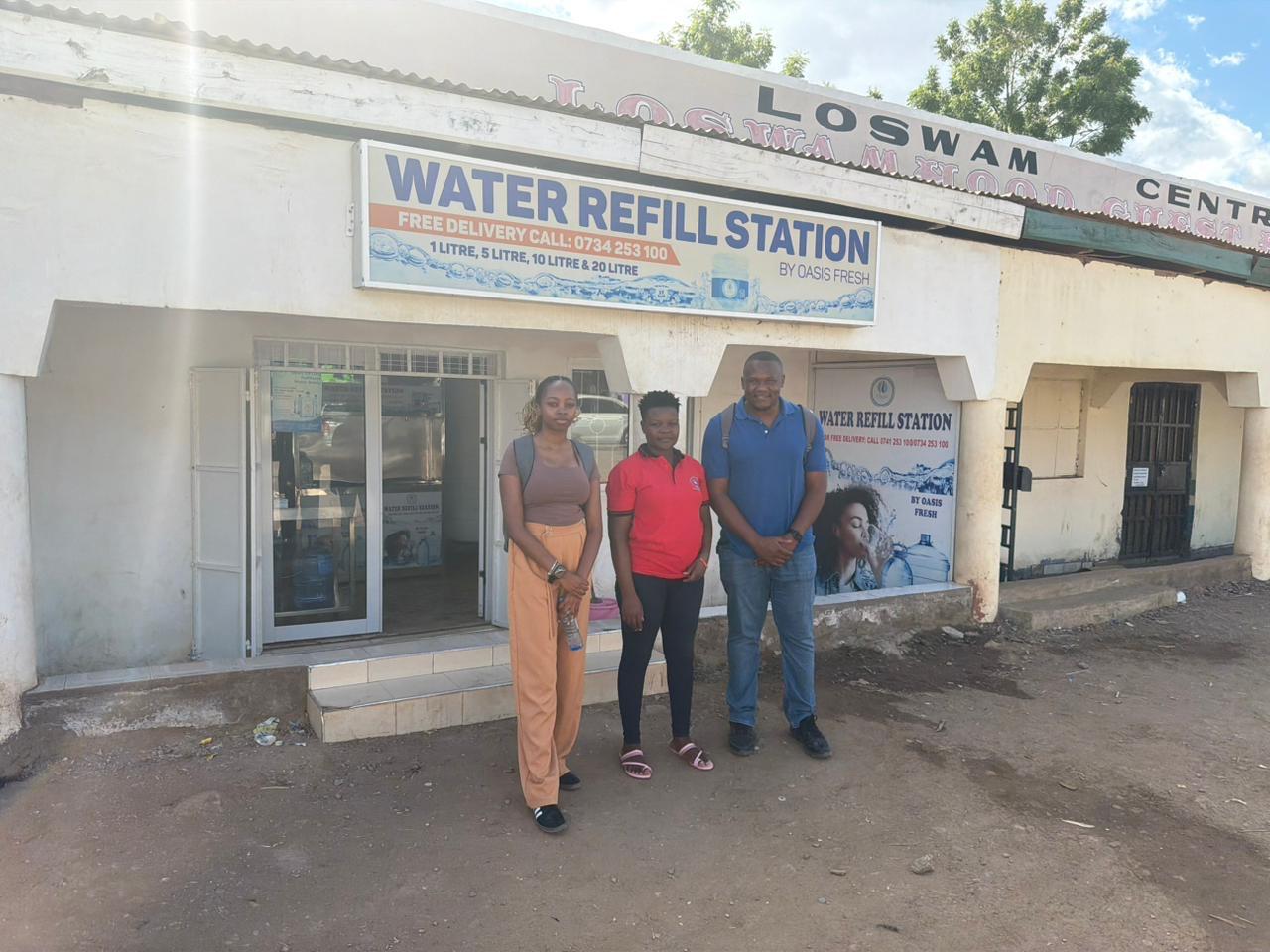
Kakuma and Kalobeyei in Turkana County are often discussed through the language of humanitarian need: water scarcity, aid systems under pressure, environmental strain, and limited economic opportunity. Those realities matter, and they are real.
But they are not the whole story.
Kakuma is also a market. People buy and sell. Businesses operate. Goods move. Demand exists. And when that demand is met through businesses that are built for local realities, the result is more than service delivery. It is infrastructure for everyday life.
That is what makes LIFTA Kenya Limited worth paying attention to.
A business built for local realities
Founded in Kakuma in 2021, LIFTA was established to address two very practical challenges at once: the need for affordable, safe drinking water and the growing burden of plastic waste in one of Kenya’s largest refugee-hosting areas.
Today, the company operates an integrated model that combines bottled water production with PET recycling. Its water business has installed capacity of 60,000 litres per day, with products distributed across Kakuma town and refugee settlements, and around 80% of sales reaching refugee settlements. Alongside this, LIFTA operates Northern Kenya’s first PET crushing and recycling plant, building a circular economy model around collection, processing, and reuse.
What is notable here is not just the business model itself, but the way it responds to the context around it. In a place where access to reliable water remains uneven and plastic waste accumulates quickly, LIFTA has built a business around problems that are visible, immediate, and commercially relevant.
This is not a pilot. It is a local operator with market traction.
Inclusive by design
LIFTA’s inclusion model is not an add-on. It is part of how the business works.
Refugees make up 60% of its casual workforce and 44% of its permanent staff, across production, logistics, distribution, and waste collection. The company also works with refugee-led Community-Based Organizations for plastic collection and distribution, helping formalize income streams and deepen local participation in the business.
Its reusable bottle model adds another layer to this. Bottles are provided free of charge, and customers pay per refill, helping improve affordability while reducing reliance on single-use plastic. It is a simple model, but an important one: practical, repeatable, and grounded in how households and institutions actually buy water.
Taken together, this makes LIFTA more than a water company. It is part of a wider system of livelihoods, distribution, and waste management in Kakuma.
Why this investment matters
Through the Refugee Investment Facility, LIFTA is receiving a senior secured loan to support the next phase of its growth. The financing will help expand production capacity, strengthen working capital, scale recycling operations, and support the integration of additional machinery as the business grows.
Over the loan period, LIFTA aims to:
- reach50,000+ refugees and host community memberswith affordable bottled water
- engage20+ refugee-led CBOsin distribution and recycling
- collect and recycle500+ tons of PET plastic annually
- createadditionalemployment opportunities, including 15–20 new jobs in the first year
This matters because it shows what investment in displacement-affected markets can look like when it is anchored in the economics of the place itself. Not externally imposed. Not charity dressed up as business. But a company built inside the market, responding to real demand and solving real operational gaps.
It also matters because this is RIF’s first investment in Kenya. That gives the transaction significance beyond the company itself. It reflects geographic expansion, yes — but more importantly, it reflects confidence in the type of businesses that can grow in refugee-hosting markets when capital is structured appropriately.
What this says about capital in displacement contexts
Markets like Kakuma are often overlooked not because there is no demand, but because the businesses operating within them are seen as too complex, too fragile, or too difficult to finance on conventional terms.
That is precisely where the Refugee Investment Facility is meant to operate.
By combining impact-linked finance with technical assistance, the RIF supports businesses that are commercially viable, locally embedded, and capable of generating measurable benefits for refugees and host communities. In LIFTA’s case, that means backing a company that improves access to water, creates employment, and strengthens circular economy practices in the same place, through the same operating model.
At a time when displacement pressures are rising globally, the case for practical, investable solutions in host markets is only becoming stronger.
LIFTA is a strong example of what that can look like: a business built in Kakuma, shaped by Kakuma, and now positioned to scale.
About the Refugee Investment Facility
The Refugee Investment Facility (RIF) seeks to address the challenges of unemployment, lack of economic opportunity, and limited access to services and goods faced by refugees and their host communities.
Through impact-linked loans, the RIF enables enterprises to maintain or strengthen their focus on refugee and host community populations, grow their businesses, and be financially rewarded through interest rate reductions tied to direct and measurable impact.
Learn more about the RIF.
RIF’s co-managers
The Refugee Investment Facility is implemented in partnership between the Danish Refugee Council (DRC) and iGravity.
DRC brings deep experience in supporting forcibly displaced people and their host communities across the spectrum from emergency response to durable solutions. iGravity brings impact investment expertise and experience structuring and managing innovative finance vehicles in emerging and frontier markets.
Together, the partnership aims to support private sector-led solutions that expand economic opportunity, services, and resilience in displacement-affected contexts.