
From Inputs to Outcomes: Reflections from Two Summits on the Future of Financing in Colombia
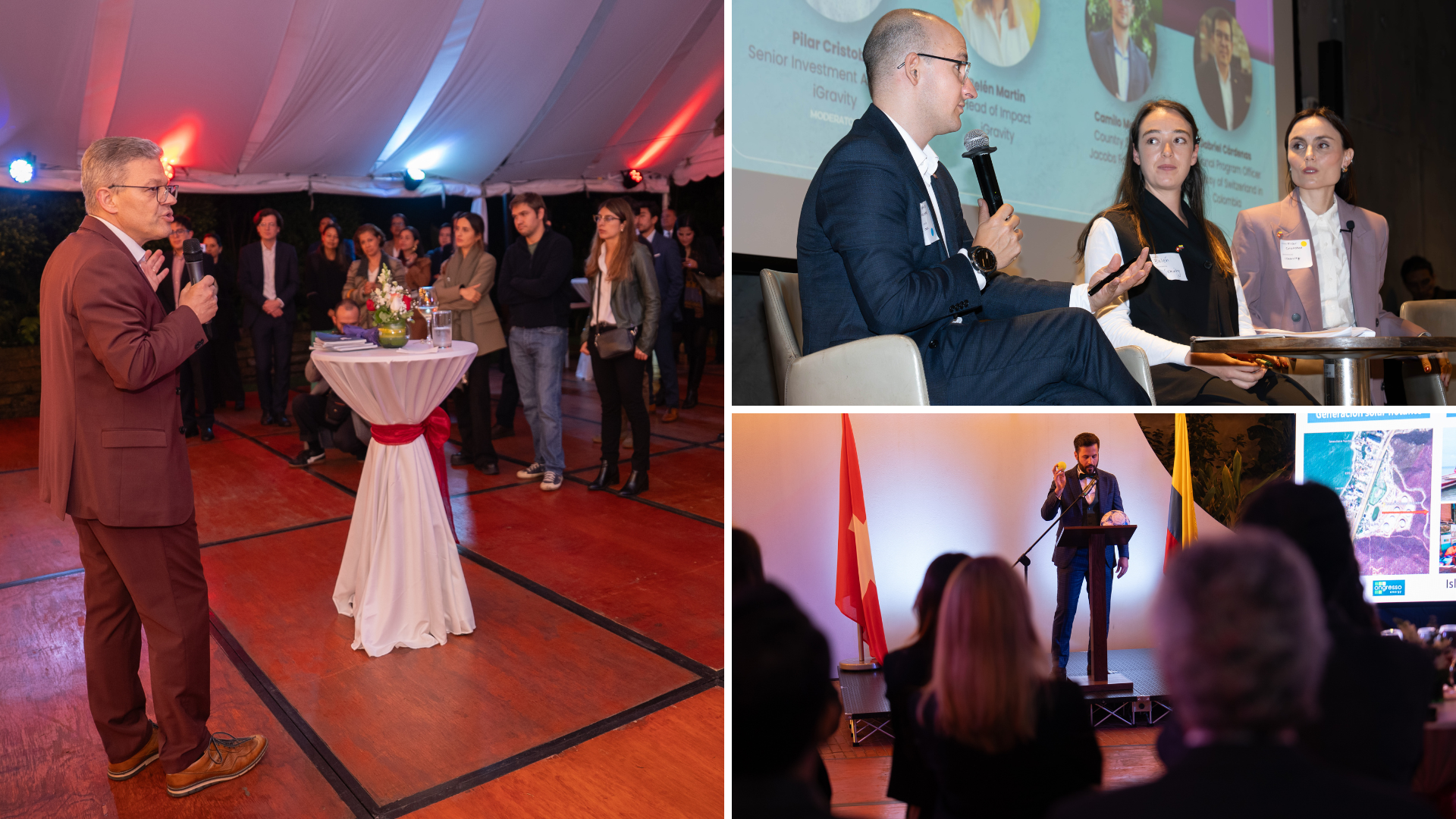
Last week in Bogotá, iGravity hosted two summits exploring how financing models can evolve to better support measurable social outcomes.
While the settings were different — one an intimate gathering of senior leaders and seasoned experts at the Swiss Embassy Residence, the other a larger public convening focused on education financing — both discussions pointed toward the same reality: traditional development financing models are under increasing pressure, and there is growing interest in approaches that align capital with outcomes.
A changing financing landscape
The first event, held at the Swiss Embassy Residence, brought together approximately 80 invited guests from across the public, private, and development sectors.
The discussion focused on outcome-based financing initiatives and the role innovative financing approaches can play in a context shaped by constrained public budgets, shifting donor priorities, and declining Official Development Assistance (ODA).
During the evening, iGravity presented both the Impact-Linked Fund for Education (ILF Education) and the SECO Startup Fund (SSF), highlighting how blended and impact-linked instruments can support enterprises while maintaining a focus on measurable outcomes.
Closing the discussion, Lucas Tschan, Head of Advisory at iGravity, emphasized that impact-linked finance is becoming increasingly relevant precisely because development actors are being asked to achieve more with limited resources. He also emphasized the necessity to collaborate with the private sector to achieve sustainable and long-term development.
Rather than replacing public systems, the discussion focused on how catalytic and private capital can complement them — supporting scalable, sustainable solutions while maintaining accountability and impact.
Moving from theory to implementation
The second convening, “Linking Financing to Measurable Education Outcomes in Colombia: Insights from the Impact-Linked Fund for Education,” shifted the discussion from high-level financing trends to in-practice implementation.
The event brought together funders, education enterprises, public sector representatives, and ecosystem actors to explore how outcome-based finance is already being applied in the education context in Colombia.
Over the past year, ILF Education — supported by the Swiss Agency for Development and Cooperation (SDC) and the Jacobs Foundation — has been actively developing a pipeline of education enterprises in the country.
To date:
- More than 50 organizations have been screened
- Over 15 enterprises have been evaluated
- Four transactions have already been signed with Colombian education companies
These transactions combine financing with technical assistance, supporting enterprises not only with capital, but also with tools related to impact measurement, verification, and performance management.
Throughout the discussions, speakers explored both the opportunities and the complexity of implementing impact-linked finance models.
Conversations touched on:
- The shift from input-based to outcome-based financing
- The design of instruments such as Social Impact Incentives (SIINCs) and Impact-Linked Loans (ILLs)
- Trade-offs between rigor, cost, feasibility, and scalability
- The importance of evidence, measurement, and verification systems
- The need for collaboration across ecosystem actors
One message emerged consistently: impact-linked finance is not a simple solution, but it is increasingly proving workable in practice.
What we are seeing in Colombia
Across both events, several important signals became clear.
There is growing interest in outcomes-based financing approaches as traditional funding models face increasing constraints.
There is also clear recognition that private sector solutions will be essential to improving education outcomes at scale.
At the same time, Colombia is showing strong early traction. The country is home to a growing ecosystem of education enterprises actively seeking patient, impact-aligned capital, alongside public, philanthropic, and private actors interested in exploring new financing approaches.
For iGravity, these conversations reinforced that the discussion around impact-linked finance in Latin America is no longer theoretical.
Momentum is building.
And increasingly, the focus is shifting from whether these models can work, to how they can be implemented effectively, responsibly, and at scale.
If you are interested in learning more about ILF Education or exploring opportunities for collaboration, feel free to reach out to us at impact@igravity.net