
BALIM Annual Report 2025
Picture a coffee cooperative in Eastern Uganda connecting thousands of smallholder farmers to certified export markets.
The cooperative aggregates coffee from local producers, processes it, and connects farmers to buyers that would otherwise be difficult to access individually. In doing so, it helps create more stable demand, strengthen local value chains, and support rural livelihoods.
But businesses like these often operate with highly seasonal cash flows, long working capital cycles, and limited access to financing that reflects the realities of rural markets.
For many traditional lenders, they are considered too small, too seasonal, or too difficult to finance through conventional lending models.
For microfinance, they are often already too large.
They find themselves in the ‘missing middle’.
This is the gap BALIM was established to address.
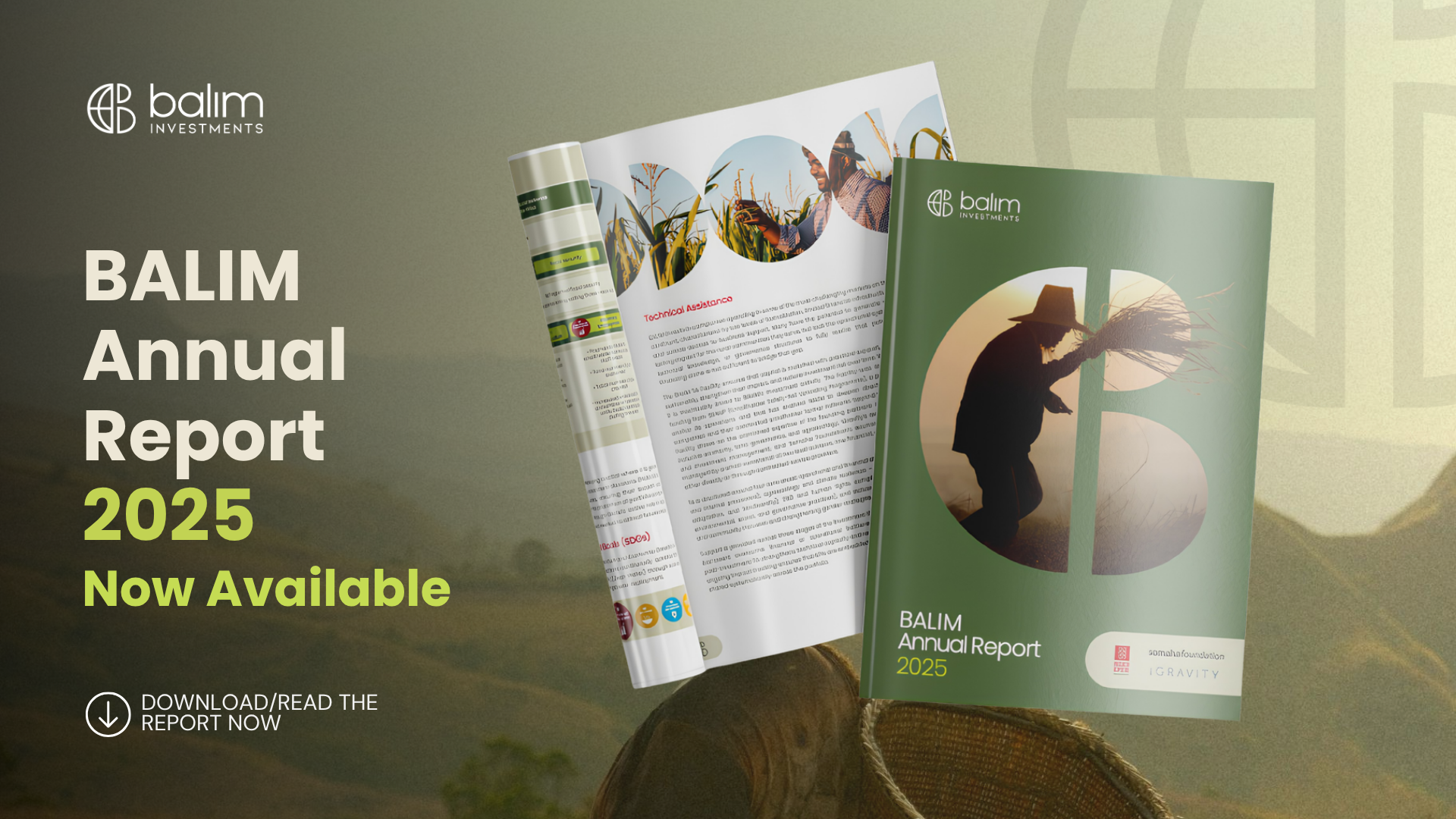
Today, BALIM is pleased to release its Annual Report 2025, reflecting its second full year as an open-ended investment facility supporting rural African enterprises through debt financing and technical assistance.
The report explores what happens when enterprises like these gain access to financing designed around the realities of rural markets — and the impact that follows for farmers, communities, and local economies.
Supporting Rural Enterprises Requires Different Tools
Established by HEKS/EPER, Somaha Foundation, and iGravity, Balim Investments aims to improve rural livelihoods by providing loans and technical assistance to African companies operating in the agriculture, water, and energy sectors.
Its blended finance structure combines equity, debt, and grant capital, allowing BALIM to mobilise different forms of capital in support of enterprises operating beyond the reach of traditional finance.
In 2025, BALIM further refined its investment approach, increasing its focus on shorter-tenor working capital and trade finance solutions aligned with SME operating cycles, while reducing exposure to longer-term capital expenditure financing.
The objective remains unchanged: ensuring that rural African enterprises can access financing structures that reflect the realities of how they operate.
What the Report Reveals
The report reflects a year marked by climate shocks, currency pressures, compressed margins, and tightening development finance across many markets.
Against this backdrop, BALIM-supported enterprises continued purchasing from farmers, supporting employment, expanding access to energy, expanding access to water, and strengthening rural value chains.
Across 13 portfolio companies operating in Uganda, Senegal, and Tanzania, BALIM-supported enterprises contributed to:
- 1,097,600 beneficiaries reached
- 14,472 smallholder farmers reached
- 28,206 people with improved access to clean energy products and services
- 1,040,552 people with improved access to water
- USD 10.8 million in purchases from smallholder farmers
The growth in purchases from smallholder farmers is particularly significant. As the report notes, it is one of the clearest indicators of the depth of BALIM’s market-linkage impact and reflects the role portfolio companies play not only as borrowers, but as buyers, processors, service providers, and market connectors within rural economies.
The year also marked several important milestones for the facility, including BALIM’s first investment in Tanzania, the formal establishment of the Technical Assistance Facility with support from SSNUP, and the addition of Peace Watch Foundation and LED as partners.
Beyond Capital
The report reinforces a lesson repeatedly encountered across rural markets: financing alone is not sufficient.
Many enterprises operate in environments characterised by low levels of formalisation, limited access to business support services, and operational challenges that extend beyond capital needs.
To address this, BALIM formally established its dedicated Technical Assistance Facility in 2025, funded through an initial grant from SSNUP.
The facility supports investees across four areas:
- Operational and financial strengthening
- Agroecology and climate resilience
- ESG and human rights compliance
- Inclusion and gender
Support is provided before investment, during implementation, and throughout impact monitoring and reporting.
The goal is straightforward: ensuring that financing is matched with practical support that helps businesses grow sustainably, strengthen their impact, and build resilience over time.
Impact in Practice: Technical Assistance at Kumba
Technical assistance is a core component of BALIM’s approach. The report explores this through the example of Kumba, a Senegal-based food processing company specializing in cereals, legumes, fruits, and vegetables marketed under the “Kumba” brand.
In 2024 and 2025, BALIM supported Kumba through an SSNUP-funded technical assistance project focused on farmer training, cooperative development, market linkages, and internal capacity building.
On farmer training, 279 lead farmers participated in structured training sessions, with each farmer expected to cascade knowledge to at least five additional group members, creating the potential to reach approximately 1,395 farmers in total. The extent of adoption across the wider network is still being assessed.
On market linkage, approximately 4,140 producers were organized into four new cooperatives, while around 1,000 farmers delivered produce directly to Kumba in 2025, reducing reliance on intermediary traders.
Internally, Kumba also strengthened its financial management systems through improved expense tracking, clearer reporting processes, and better alignment with BALIM’s monitoring requirements.
The case also reinforced several lessons that are now shaping BALIM’s approach to future technical assistance engagements: agricultural seasonality must be reflected in project timelines from the outset, informality at both company and farmer level needs to be incorporated into project design, and market linkage gains require continued follow-up to be sustained.
Looking Ahead
The report also reflects candidly on the challenges encountered throughout the year and the lessons that followed.
Portfolio quality pressures, agricultural market volatility, cross-border operating complexity, and legal and regulatory differences across markets shaped BALIM’s experience in 2025.
These experiences informed several important adjustments, including shorter-tenor financing aligned with SME operating cycles, earlier legal and collateral due diligence, deeper technical engagement, and a more focused geographic strategy.
Together, these lessons are contributing to a clearer understanding of what responsible, durable impact lending in rural Sub-Saharan Africa requires.
BALIM entered 2026 with a stronger technical assistance offering, a clearer investment focus, and continued ambition to support rural African enterprises operating in sectors that are critical to rural livelihoods.
The BALIM Annual Report 2025 is not simply a reflection on the year that passed. It is a reflection on what BALIM continues to learn about financing rural African enterprises operating in the missing middle — and the role that blended finance, technical assistance, and disciplined investment can play in strengthening rural economies.
Read the report now: BALIM Annual Report 2025