
From Capital to Change: How Emerging Market Debt Is Powering Real Impact
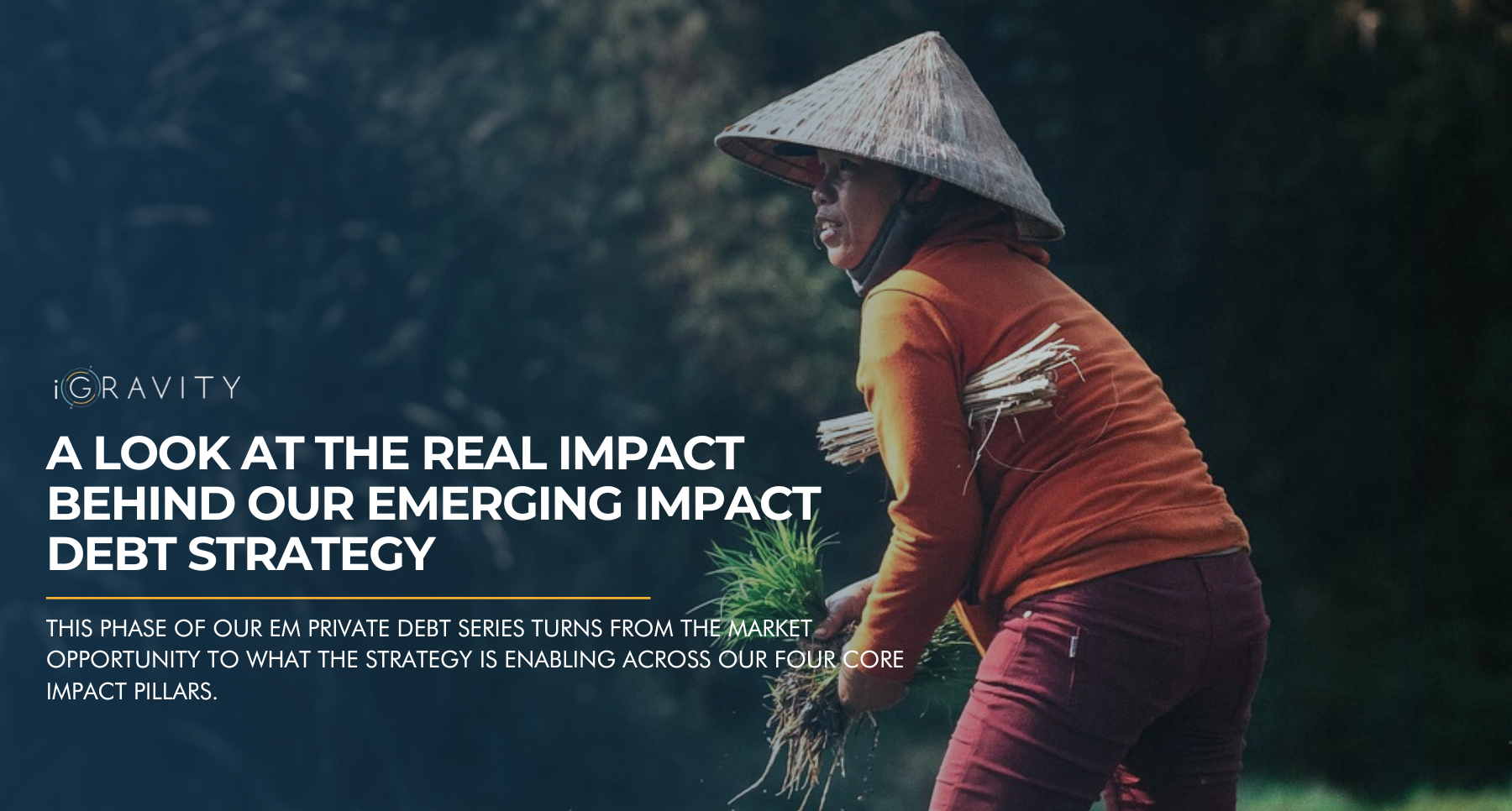
In Phase 1 of our EM Private Debt series (a series designed to unpack misconceptions around investing in emerging markets and highlight the structural opportunity behind Emerging Market Private Debt), we explored why Emerging Markets Private Debt is becoming increasingly important for investors navigating volatility, high correlations, and shifting global dynamics. Today, that conversation naturally moves from why to what:
- What happens when this capital reaches the real economy?
- What changes do we actually see on the ground?
- And what do the results we are observing across our portfolio tell us about the potential of our Emerging Impact Debt Strategy, and generally, EM Private Debt?
Across our portfolio, we are beginning to see how our Emerging Impact Debt Strategy contributes across four key impact areas — Basic Needs, Inclusive Economies, Climate Change Mitigation, and Natural Ecosystems. When capital is structured responsibly and deployed with the intention to generate positive changes, it strengthens access to essential services, supports local enterprises, expands climate solutions, and helps protect the natural systems that people rely on.
The insights and results shared below draw from our Investment Solutions 2024 Financial & Impact Performance Report, based on impact data reported directly by our portfolio companies. In line with our methodology, all figures reflect the total impact generated during 2024 and are proportionally attributed to our share of investment.
The Context: A Financing Gap Too Large to Ignore
For decades, development finance has been constrained by an uncomfortable reality: needs are rising faster than public resources can respond. Developing countries face an annual USD 4 trillion SDG financing gap, intensified by climate shocks, demographic pressures, geopolitical uncertainty, and shrinking fiscal room. This gap ends up manifesting itself in underfunded healthcare systems, fragile food supply chains, overstretched local enterprises, and millions of people still excluded from basic services.
Yet global finance is shifting!
Impact investing has surpassed USD 1.57 trillion, and private debt — a rapidly expanding segment — has moved into the mainstream. Nearly half of global institutional investors now rank private debt as their preferred tool for income generation, and family offices have doubled their allocations just in the last year.
Emerging markets sit at the center of this shift. Their growth cycles diverge meaningfully from traditional markets, offering rare diversification. As the World Bank notes, North American GDP growth correlates 0.64 with Europe, but only 0.13 with Sub-Saharan Africa and 0.03 with South Asia — a reminder that emerging markets move to different rhythms.
Amid this landscape, private debt stands out as a responsive, scalable financing tool for enterprises that drive essential services, local livelihoods, and climate resilience.
Four Pillars of Impact: What Our Emerging Impact Debt Strategy Is Enabling
Below, we explore how our Emerging Impact Debt Strategy is contributing across four key impact areas, combining quantitative results with real stories from the field.
-
Basic Needs
Across emerging markets, access to essential services is still uneven. Education remains unaffordable for many families, housing is often inadequate, and healthcare costs continue to push people into financial vulnerability.
In 2024, our Emerging Impact Debt Strategy enabled capital to reach enterprises expanding access to these foundational services. This translated to:
- 1,749 people gaining access to education
- 1,049 households securing improved housing
- 5,644 individuals accessing health or household finance services
Behind these figures are people navigating real barriers — from students seeking opportunities abroad to families looking for safer living conditions.
Case Study: Financing Higher Education for Global Talent
Higher education remains one of the strongest drivers of economic mobility, yet financing is often inaccessible in emerging markets. Traditional lenders typically require collateral or domestic credit histories, which many international students simply don’t have.
The Credit Suisse Prodigy Note changes this by enabling Prodigy Finance to provide student loans based on future earning potential. Since its inception in 2014, the model has funded over $1.5 billion in loans for 28,000+ students from 150 countries, with more than 75% coming from emerging markets.
The opportunity is life-changing. Over 77% of graduates report their salaries more than doubling after completing their degrees. One example is Maria from Colombia, who dreamed of studying engineering abroad but lacked financing options. A Prodigy loan enabled her to complete her degree and secure a strong job outcome — showing how education financing can unlock talent and support long-term mobility.
-
Inclusive Economies
Small and medium enterprises make up the backbone of emerging market economies, yet they consistently struggle to access affordable finance. The global MSME financing gap — estimated at USD 5–5.7 trillion — highlights just how much potential remains unmet.
In 2024, our Emerging Impact Debt Strategy contributed to narrowing part of this gap. Across our portfolio, capital enabled:
- USD 25.7 million deployed to MSMEs, including micro, small, and medium-sized enterprises that provide most jobs, supply essential goods and services, and anchor economic resilience in emerging markets
- 6,161 enterprises supported
- 68%women-owned
- 64%locatedin rural areas
- 54,744individuals reached through remittance services
These outcomes reflect a growing shift: when financing reaches women, rural entrepreneurs, and community businesses, the benefits ripple outward — supporting jobs, incomes, and local economic resilience.
Case Study: Ilu Women’s Empowerment Fund — Gender, Finance & Climate Resilience
Across Latin America, the Ilu Women’s Empowerment Fund, managed by Deetken Impact (one of our investees), offers a powerful example of how gender-lens investing and climate action can reinforce each other.
In Q2 2025, the fund reached more than 500,000 clients, 65% of whom are women, through inclusive financial institutions and enterprises working in renewable energy, housing, and agriculture.
- In Ecuador, Fundación Espoir deployed over USD 2 million in green loans, helping women entrepreneurs adopt climate-resilient technologies.
- In Colombia, Dispower expanded off-grid solar access to 12,000 households and 48,000 people, employing local women as Social Managers.
- Two partners —AvanzaSólido (Mexico) and Espoir (Ecuador) — were recognised under the 2X Challenge for advancing gender equity.
Across its portfolio, the Fund supports 5,300 full-time jobs and a 22 MW plant that reduces 24,000 tons of CO2 annually and generate 19 GWh per year of clean energy — illustrating how well-designed financing can reinforce economic participation and climate resilience.
-
Climate Change Mitigation
Emerging markets are the most vulnerable to climate change and the most pivotal to global mitigation efforts. Emerging markets are the most vulnerable to climate change and the most pivotal to global mitigation efforts. In these contexts, expanding access to clean and reliable energy is not only an environmental priority but also a practical way to support households, small businesses, and essential services that depend on stable power. Clean energy access, therefore, becomes a key link between reducing emissions and improving everyday resilience.
In 2024, our Emerging Impact Debt Strategy enabled financing for enterprises expanding renewable energy solutions and low-carbon technologies. This resulted in:
- 3,997 people gaining access to clean energy
- 9,957 MWh of renewable energy generated or saved
- 12,936 tonnes of CO₂avoided annually
These results come from solar distributors, mini-grid operators, and productive-use energy companies such as solar irrigation & cold storage entities operating in underserved regions where energy access is far from guaranteed.
Case Study: Charm Impact — Clean Energy for Communities Across Africa
More than 600 million people in Sub-Saharan Africa still lack reliable electricity — a constraint that affects everything from healthcare delivery to local business growth.
Our investment in Charm Impact supports innovative clean-energy enterprises responding to these realities.
- In Uganda’s West Nile region, Fena Solar provides solar-powered refrigeration and productive-use appliances to women-led fish trading cooperatives. This helps reduce post-harvest losses and stabilise incomes across 13 districts, including refugee and host communities.
- In Nigeria, Havenhill Synergy has electrified 60+ healthcare facilities, improving services for over 700,000 patients annually, while its mini-grids provide clean power to 300,000+ people across 30+ off-grid communities.
Through Charm Impact, our Emerging Impact Debt Strategy contributes to expanding practical, community-focused clean energy solutions that support resilience and local development.
-
Natural Ecosystems
Healthy ecosystems form the backbone of rural economies in many emerging markets. Strong soils, balanced watersheds, and regenerative agricultural practices protect livelihoods as much as they protect landscapes.
In 2024, our Emerging Impact Debt Strategy enabled financing for enterprises focused on sustainable agriculture, land restoration, and circular economy solutions. This contributed to:
- 242 agricultural MSMEs receiving financing
- 89 farmers trained in sustainable practices
- 6,409 hectares protected or restored
- 830 tonnes of waste recycled
These outcomes highlight how targeted capital can reinforce the environmental systems that support rural prosperity.
Case Study: FairCapital Coffee Certificate — Scaling Sustainable Agriculture in Latin America
A good example is the FairCapital Coffee Certificate, co-seeded with the Abendrot pension fund in early 2024. This initiative expands responsible financing across Latin America’s coffee-growing regions, where climate pressures and economic challenges intersect.
Through this investment:
- 602 smallholder farmers were trained in sustainable farming
- 15 agricultural MSMEs received financing to grow their operations
- 1,934 hectares of farmland were sustainably managed
This approach strengthens soil health, improves long-term productivity, and supports climate-resilient livelihoods. Building on strong results from past years, our Emerging Impact Debt Strategy is now expanding participation, helping deepen access to responsible financing across these supply chains.
Looking Ahead — Scaling What Works
The early results of our Emerging Impact Debt Strategy point to a consistent reality:
Private debt can play a meaningful role in financing essential services, supporting local enterprises, advancing climate solutions, and reinforcing natural ecosystems when deployed with purpose.
Our EID Strategy does not claim to close global financing gaps — no single approach can. But it does offer a disciplined, scalable way to direct capital toward enterprises whose work strengthens resilience and opens opportunities for the communities around them.
As investor interest grows, enterprise demand rises, and traditional lenders retrench across emerging markets, the significance of this work becomes even clearer. The opportunity ahead lies not only in deploying more capital, but in deploying it with purpose, accountability, and a focus on real outcomes.
This is where capital and change meet — and where the next chapter of our Emerging Impact Debt Strategy continues to unfold.